

About 35 small older buildings holding roughly 110 households sit in the affected 4a and 5b districts on lots that by-right rules could redevelop at three to eight times their current density. But almost all of them also lie inside the Narberth Historic District, where demolishing a pre-1945 building needs Borough Council's approval regardless of zoning. That review, not the zoning, is what now stands between these renters and the teardown math.
Inside the developer’s mind
A developer with a sharp pencil hunts for opportunities in the 4a and 5b zones after the amendments pass.
The teardown premium under the new zoning is what a developer can pay for the land plus the old building (its residual land value) minus what the building is already worth as an income stream (its existing-use value). When that gap is positive, demolition pays. When it is negative, the old building is worth more standing. A positive gap is a risk for renters.
What the old building is worth standing. Take the building type that fills these blocks: a three-unit building on a modest lot. It throws off roughly $44,000 in net operating income, which at a 6% cap rate values it around $740,000. Two recent sales in these districts confirm that: 204 Grayling, three units, sold for $737,500 in June 2026, and 106 Hampden, three units, for $918,000 in January 2026. The hurdle is approximately $800,000. (204 Grayling was built in 1900 and sits inside the historic district, so a developer would need Borough Council’s approval to demolish it. 106 Hampden dates to 1960, is not a contributing building, and carries no such protection. The older, cheaper building is the harder one to tear down, dispite the teardown math.) The $800,000 is what a developer has to clear before touching it. A larger six-unit building sits higher, around $1.3m, and is harder to justify tearing down, but six-unit buildings are the exception here. Of the 35 small buildings in these districts, one has six units; 26 have two or three.
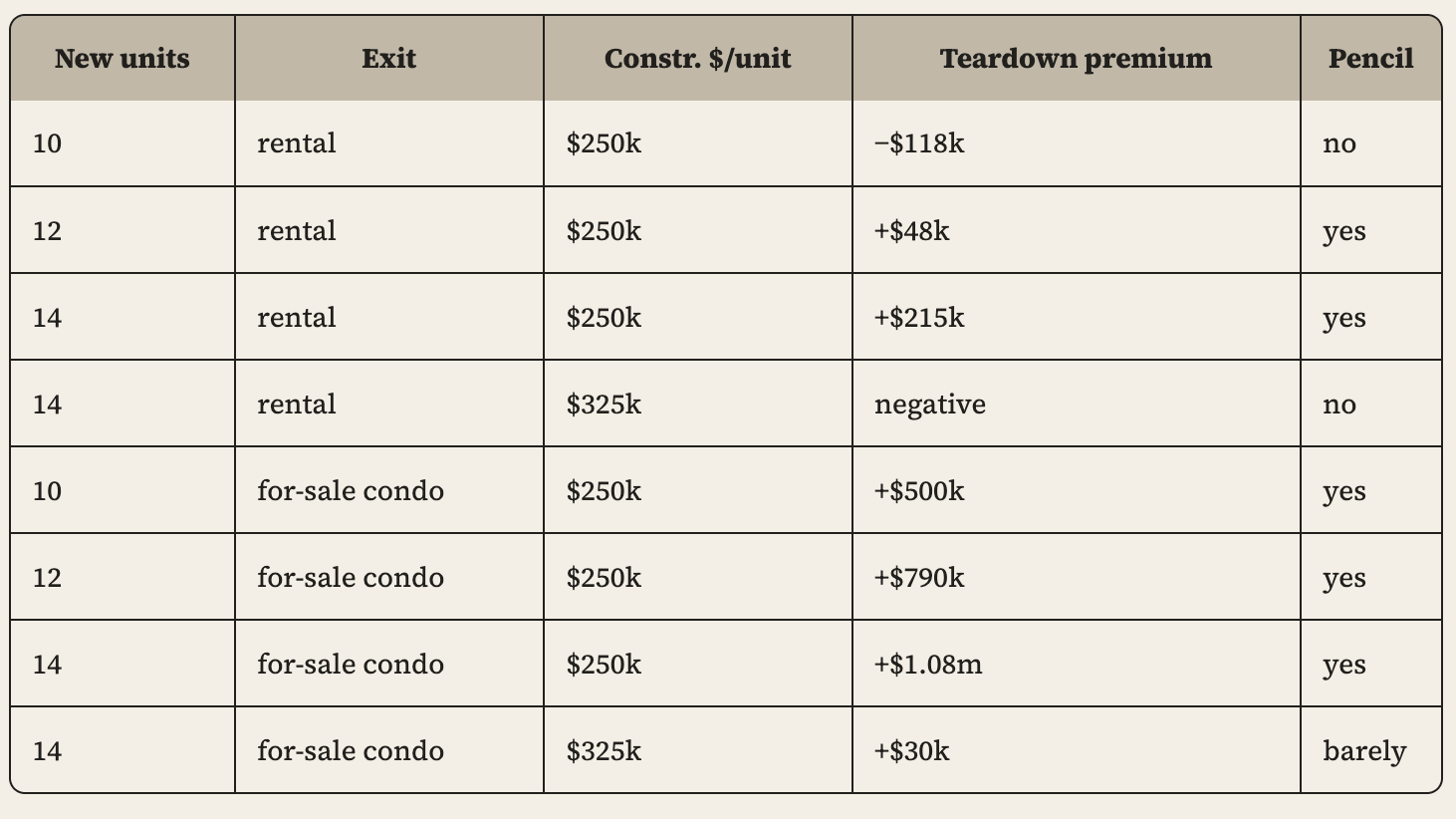
When redevelopment can pay. The new by-right building must cover that hurdle plus demolition, construction, and a developer’s profit. A lot of 6,000 to 7,500 square feet, the typical size under one of these three-unit buildings, supports roughly 10 to 14 new units. Running it with the CRE Development 101(Council presentation) rent figures, a $500,000-per-unit condo sale price against the borough’s $595,000 median home, and national mid-rise construction costs of $250,000 to $325,000 per unit, here is the teardown premium (new residual land value minus the roughly $800,000 existing value) for a three-unit teardown:
Setting aside Council approval in the historic district, three conclusions come out of this.
First, against a three-unit hurdle, a new rental building is worthwhile once the lot yields about a dozen units, which most do. Replacing three units with twelve rentals clears the standing value by roughly $48,000, and the margin grows as the unit count rises. Rental replacement works for the stock that dominates here.
Second, for-sale condos are worthwhile at nearly every yield. In a borough with a $595,000 median home, a developer captures more value per unit by selling than by renting, and the premium runs from half a million dollars upward. For-sale condos are the strongest demolition channel.
Third, the buildings most exposed are the lowest-value ones. Low in-place income means low existing-use value, which is the easiest hurdle for the teardown premium to clear. The oldest, lowest-rent buildings are the most vulnerable to teardown. A well-kept building charging market rents is comparatively safe because its standing income value is high.
There’s also a link to parking. Construction cost per unit is the most sensitive input, and structured parking is the biggest single line item. A lower parking mandate lowers per-unit cost, which raises the teardown premium. A 0.7-space rule would make demolition worthwhile on more lots.
The 4a and 5b districts
The 4a and 5b districts contain 170 parcels1 (104 in 4a, 66 in 5b), broken down by what’s on them today2:
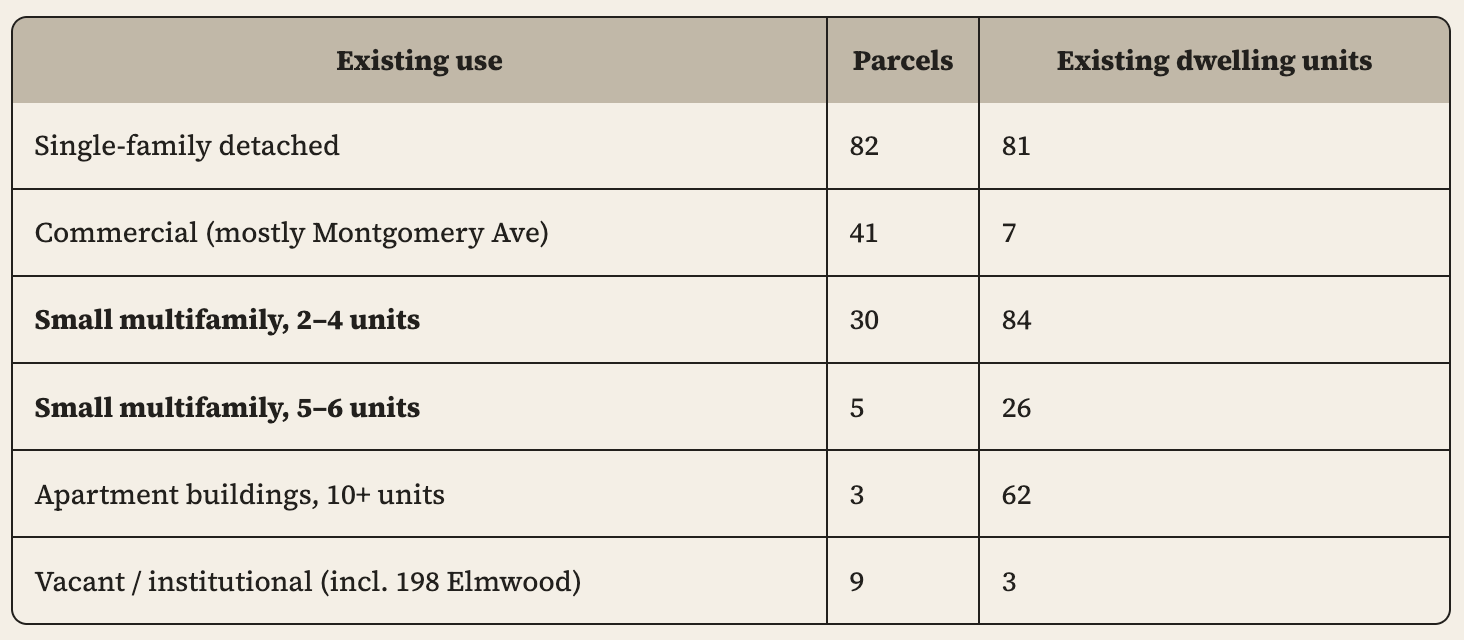
The stock in the middle rows: about 35 small two-to-six-unit buildings holding roughly 110 dwelling units. These cluster on the blocks right next to the station: Elmwood, Iona, Grayling, Dudley, Hampden, Essex, and Windsor. Owner mailing addresses in the assessment records suggest about two-thirds are absentee-owned, a good proxy for rental; most of the rest are duplexes where the owner lives in one unit and likely rents the other. So about 95 to 110 of these units are tenant-occupied. They are Narberth’s older, lower-rent housing, and they are the parcels where the teardown premium can turn positive.
The reason they’re exposed shows up in the lot sizes. A typical two-to-three-unit building here sits on 5,000 to 8,000 square feet. Under by-right multifamily rules, those lots could carry roughly 10 to 25 units, three to eight times what stands there now. Applying the teardown threshold from the model the exposed count comes out as a range depending on how much the new rules let a developer build
As we read the proposed amendments, apartments go by-right only on lots above some undefined minimum area, a threshold not yet in any ordinance text. If that threshold is larger than the 4,000-to-7,000-square-foot lots that most of this small stock sits on, then the by-right path on those parcels is stacked townhouses or row-homes rather than apartments, which lowers the yield. It still exceeds the existing two or three units, so the teardown incentive survives in weaker form. Pinning down the minimum lot size and any density cap in the ordinance text is a question for Council.
The historic-district check
The teardown math above assumes a developer can clear the old building once the numbers work. On most of these lots, they cannot, at least not on a by-right permit alone. Almost all of this stock sits inside the Narberth Historic District.3
The district was adopted in July 2021 under the Pennsylvania Historic District Act.4 Its boundary is a map, Appendix A to Chapter 315, and its period of significance runs “through 1945.” A building inside the boundary that was built in or before 1945 is considered a contributing resource.
What being “contributing” means for a developer is set out in § 315-7: a property owner “must obtain a certificate of appropriateness if a contributing resource is proposed to be demolished,” and that certificate is “required in addition to any other necessary permits, and regardless of whether building, zoning, or any other permits are required.” Historic demolition review sits on top of the zoning. By-right status does not remove it. The certificate is signed by Borough Council on the Historical Architectural Review Board’s recommendation, which means a public hearing, delay, cost, and a discretionary decision, the same friction the amendments were meant to strip out of new construction.
Matching the 35 small buildings against the district map and their year of construction changes the exposure picture:
All 35 sit inside the historic district. 25 were built in or before 1945, most between 1880 and 1930, and are “contributing resources”. Demolishing any of them needs Council’s approval.
Six more carry no recorded build year and are likely old, including several of the five and six-unit buildings. Only six were built after 1945: 100, 105, 106, and 107 Hampden, 209 North Essex, and 301 Windsor. These are the small rentals a developer could clear without historic review.
So the teardown-exposed rental stock is six, the post-1945 buildings, plus the vacant and underused parcels that carry no historic building at all, 198 Elmwood chief among them. For the other 25 to 31, the historic district rather than the zoning regulates demolition.
The protection is not absolute. Section 315-12 lets the Building Code Official approve demolition of a contributing building that is structurally unsafe, which is how the derelict 1891 church at 198 Elmwood was demolished in 2023 under court supervision and the request by the Borough, even though the historic district already existed. Council can also grant a certificate rather than deny it, and owners can plead economic hardship. A building left to rot can meet the same end through demolition by neglect, which § 315-13 is written to prevent but cannot always stop. The historic district raises the hurdle but it does not lock the gate.
This is at Council’s discretion.
The larger point is one the earlier version of this article got wrong. The amendments increase the pressure to redevelop these lots. Chapter 315 is the countervailing force. The two collide directly, and for most of this stock the historic ordinance currently wins. The question worth putting to Council is therefore not only about minimum lot sizes. It is whether the recodification or any future amendment weakens the demolition review in Chapter 315, because that review, far more than the zoning, is what protects these renters today.
Recent sales in the source data:
204 Grayling, 3 units, June 2026, $737,500 ($246k/unit)
106 Hampden, 3 units, Jan 2026, $918,000 ($306k/unit)
114 N Essex, 4 units, June 2025, $730,000 ($182k/unit)
111 Dudley, 5 units, Sept 2022, $1,000,000 ($200k/unit)
111 Iona, 4 units, Jan 2022, $775,000 ($194k/unit)
The market in these blocks is turning over: several of the small buildings changed hands in 2024, 2025, and 2026. The prices confirm the hurdle threshold. The three-unit buildings above sold for $737,500 and $918,000, and the model’s $800,000 hurdle for a three-unit teardown sits between them. These buildings are worth real money standing, which is why demolition pays only where the by-right density gain is large. On lots yielding a dozen units or more, which most of these can, the gain is large enough.
Where the cost falls depends on two rulebooks. The zoning makes the teardown worthwhile; the historic district decides whether it is allowed. For the six post-1945 rentals and the vacant parcels, the road will open. For those older buildings that house most of these renters, the wrecking ball has to get past Borough Council first. That may be all that slows this down.
Thanks for reading.
The views expressed in this article are those of the author and do not necessarily reflect the position of Our Narberth, Inc., its board, or its members.
The parcel geometry and lot sizes come from the Montgomery County Parcels GIS layer, the use, unit counts, values, and sales from the county Board of Assessment (GIS_BOA_LAND), and the 4a/5b boundaries from the county Municipal Zoning layer, all via the county’s public ArcGIS server at gis.montcopa.org. The assessed values are 1996 base-year figures, not market, so use the recent sale prices for value and treat assessments only as identifiers. ↩︎
Boundary read from the Narberth Historic District Map, Chapter 315 Appendix A: https://ecode360.com/attachment/330339/NA0447-315a%20Appendix%20A.pdf . Building ages from the county Board of Assessment (YEAR_BUILT), joined to the parcels in the inventory above. ↩︎
Borough of Narberth Code, Chapter 315, Historic Districts, adopted 12 July 2021 by Ord. No. 1034, under the Pennsylvania Historic District Act (53 P.S. § 8001 et seq.). See §§ 315-4 (districts created), 315-6 (designation), 315-7 (certificates of appropriateness), 315-12 (emergencies), 315-13 (demolition by neglect): https://ecode360.com/37956735 ↩︎
What is your assessment of the downtown apartment rentals. Are the older apartments above store fronts viable?
Anything built before and up to 1945 in Narberth falls under the HARB and cannot be torn down by right. It would have to be unsalvagable and a hardship on the seller.